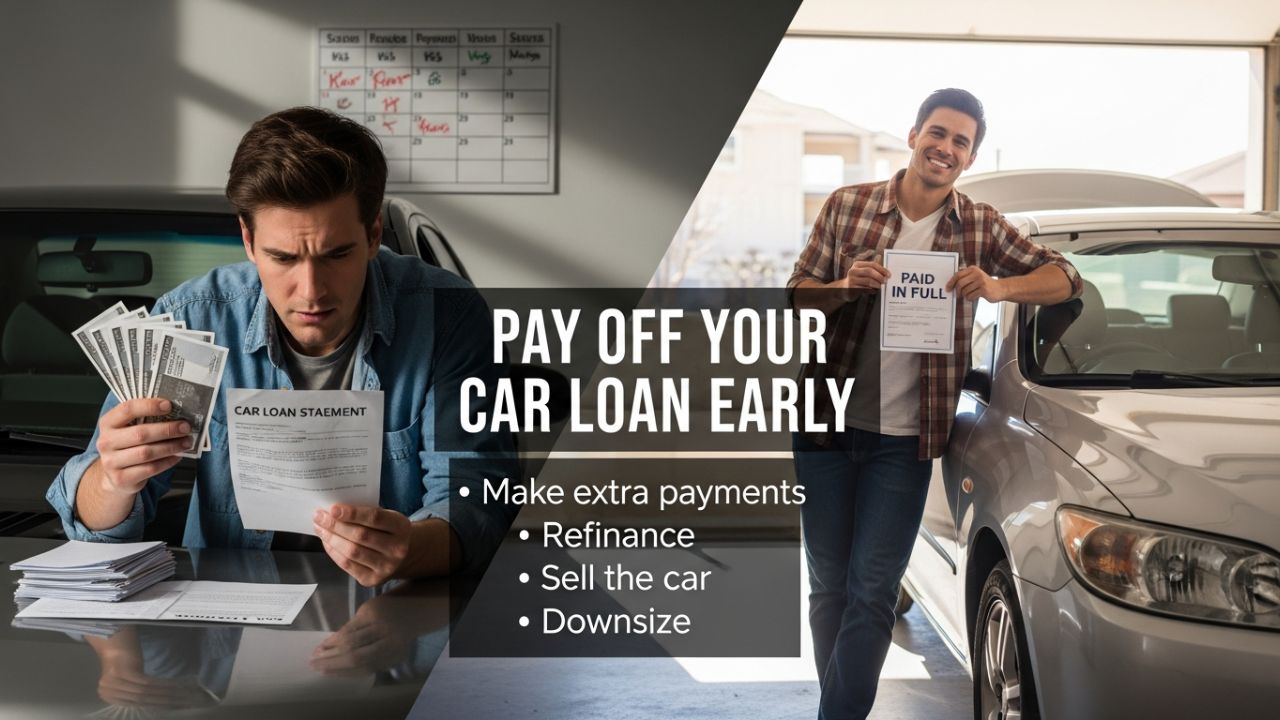
Car loans are one of the most common forms of consumer debt. While monthly payments are manageable for many, interest accumulates over time — sometimes costing you thousands of dollars across a multi-year term. Paying off your car loan early can substantially reduce interest paid, shorten the life of the loan, and often boost your credit profile. This guide walks through clear, realistic strategies (with real numbers) so you can choose the path that fits your finances and goals.
Why paying off a car loan early matters
- You save interest. Interest is the price you pay for borrowing. The faster the principal goes down, the less interest you pay overall.
- You increase equity in your vehicle. Faster payoff improves your loan-to-value ratio (important if you sell or refinance).
- Your credit mix and utilization can improve. Paying down instalment debt responsibly helps your credit score, especially if you avoid new debt in the process.
- You free monthly cash flow. No car payment frees up money for savings, investing, or emergencies.
- Peace of mind. Being debt-free is psychologically powerful.
Before you start: check for prepayment penalties & loan terms
Not all loans are created equal. Before making extra payments:

- Read your loan agreement for prepayment penalties. Some lenders charge fees for early payoff; others permit principal-only prepayments without penalty.
- Confirm how your lender applies extra payments — to principal or future payments. Ask them to apply any extra strictly to principal.
- Verify if there are late fee exceptions or caps and whether making extra payments affects autopay discounts.
Always call or message your lender and get confirmation in writing about how extra payments will be posted.
Read Also: Buy Car Insurance Online Instantly – Compare Quotes & Get Same-Day Coverage
Core strategies to pay off your car loan early
Below are practical strategies — from tiny habits to major moves — arranged roughly by ease and impact.
1. Round up your monthly payment
Round your payment up to a whole number (or an easy multiple). Small increments add up.
Example: if your payment is $483.32, round to $500 — that’s $16.68 extra per month. Over multi-year terms, that lowers principal faster.
2. Add a fixed extra each month
Pay an additional fixed amount each month (e.g., $50, $100). This predictable extra chipping away at principal shortens the loan and reduces interest.
Real example (math shown):
- Principal (P): $25,000
- Annual interest rate: 6%
- Monthly rate (r): 0.06 / 12 = 0.005
- Term (n): 60 months
Monthly payment formula:
M = P × r / (1 − (1 + r)^(-n)).
Plugging numbers:
- r = 0.005
- (1 + r)^(-n) = (1.005)^(-60) ≈ 0.740818 (rounded)
- Denominator = 1 − 0.740818 = 0.259182
- M = 25,000 × 0.005 / 0.259182 ≈ 125 / 0.259182 ≈ 483.32
So your standard monthly payment is $483.32.
If you pay an extra $100 each month (so $583.32 total):
- New payoff time ≈ 49 months (instead of 60)
- Total interest originally would be about $3,999.20.
- With the $100 extra monthly, total interest ≈ $3,206.27.
- Interest saved ≈ $792.93, and you finish 11 months early.
These figures are realistic and show how modest monthly additions meaningfully reduce interest and time.
3. Make biweekly payments
Split a monthly payment in half and pay every two weeks. There are 52 weeks in a year → 26 biweekly payments = 13 monthly-equivalents, so you make one extra monthly payment a year without feeling a big hit.
Effect: accelerates principal reduction and trims months and interest. Confirm with the lender that they accept biweekly payments and will apply them correctly (toward principal rather than holding them).
4. Make lump-sum payments from windfalls
Bonuses, tax refunds, inheritances, or sale proceeds are excellent opportunities to make big principal reductions.
Example math: If you apply a $2,000 lump sum at the start (on the same $25,000, 6% loan):
- New principal = 25,000 − 2,000 = 23,000
- Using the same monthly payment ($483.32), payoff time shortens from 60 to about 55 months, and interest paid drops by about $667.09.
- That’s significant for one-time action.
5. Refinance to a lower rate
Refinancing replaces your existing loan with a new loan — ideally at a lower interest rate or better term. Benefits:
- Lower monthly payment and/or less interest over the life of the loan.
- If you shorten the term while keeping payments similar, you pay less interest and finish earlier.
But watch for:
- Refinancing fees and the total cost over time.
- Credit score and income requirements — better rates typically require better credit.
6. Recast the loan (if available)
Recasting (or re-amortization) is when you make a large payment and the lender reworks the amortization so the payment drops while the term remains. It’s less common for car loans than mortgages but ask your lender — it can reduce interest paid if combined with shorter term.
7. Use windfalls to shorten term, not lower payment
When you refinance or recast, choose options that shorten the term rather than lower the monthly payment. Keeping payments steady while shortening the term increases principal reduction rate.
8. Trim expenses and reallocate the savings
Cut discretionary spending and funnel that into your loan. Even modest reallocation can create an extra $50–$200 per month to attack the principal.
9. Automate extra principal payments
Set up automatic transfers for your chosen extra amount and ensure the lender posts it to principal. Automation helps you stick to the plan.
10. Prioritize high-interest debt first (if you have other loans)
If you have credit card debt at 18% APR, it’s usually better to pay that down before attacking a 6% car loan. Use the snowball or avalanche methods to manage multiple debts intelligently.
How to apply extra payments correctly — checklist
- Tell the lender: “Please apply extra payments to principal only.” Get confirmation.
- Keep records of payment confirmations and account statements.
- Avoid paying extra if it triggers loss of benefits (e.g., deferred interest promo) — always check the contract.
- Recalculate payoff dates as you go (many lender websites show an updated amortization schedule when you apply extra payments).
Impact on your credit score
Paying off a car loan early can affect your credit in different ways:
- Positive effects: Lower overall debt and an improved debt-to-income ratio can boost your creditworthiness. Making on-time payments while reducing principal helps credit history.
- Neutral/temporary effects: Closing an installment account (after payoff) may slightly change your credit mix and lower the average age of accounts if it was one of your older accounts. This might cause a small, temporary dip in score for some people.
- Long-term benefits: Lower total debt and a better payment history usually outweigh small short-term changes.
Bottom line: For most people, the benefits to finances and stress levels outweigh the small credit quirks. If maximizing a credit score for an imminent mortgage or large loan is critical, consult a credit advisor before mass-paying car loans.
Tools & apps to help
Use an amortization calculator or spreadsheet to see exactly how extra payments affect your payoff date and interest. Features to look for:
- Ability to enter extra recurring payments.
- Option to add lump-sum payments at specific months.
- Exportable amortization schedule.
Many banks and independent sites offer free calculators; your lender’s website often includes one too.
Common mistakes to avoid
- Not confirming how extra payments are applied. If the lender posts extra money to future scheduled payments instead of principal, you won’t cut interest.
- Draining your emergency fund. Don’t put yourself at risk — keep 3–6 months’ living expenses before accelerating debt payments.
- Ignoring prepayment penalties. Some older or specialty loans penalize early payoff.
- Choosing lowest possible monthly payment when refinancing — that might extend the term and increase interest; instead aim for a lower rate while keeping the term reasonable.
Sample payoff plans (to inspire you)
- Conservative: Extra $50 per month. If you can only spare a little, this is consistent and still meaningful.
- Moderate: Extra $100–$200 per month. Expect substantial interest savings and significant term reduction.
- Aggressive: Biweekly payments + $200 extra per month + use of windfalls. Fastest path to debt-free but requires discipline and emergency savings.
Tax considerations
Generally, interest on personal car loans is not tax-deductible for consumers in the U.S. (unlike some mortgage interest). Businesses can deduct interest on vehicles used for business purposes — consult a tax professional to determine implications for your situation.
Example amortization snapshot (for $25,000, 6%, 60 months)
- Standard monthly payment: $483.32
- Total interest if you pay normally for 60 months: $3,999.20
- Pay $100 extra/month → payoff in about 49 months, total interest ≈ $3,206.27, interest saved ≈ $792.93.
- One-time $2,000 lump-sum at start → payoff ~55 months, total interest ≈ $3,332.11, interest saved ≈ $667.09.
These concise examples show how both consistent small additions and strategic lump sums reduce interest and term.
Frequently Asked Questions (FAQ)
Q: Will paying off my car early hurt my credit?
A: Usually not. You may see a slight, temporary change if closing the account alters your credit mix or average account age, but the long-term effect of lower debt and on-time payments tends to be positive.
Q: Should I use a credit card to pay off a car loan?
A: Generally no. Credit cards often have higher APRs than car loans, and transferring auto debt to high-interest credit cards can cost more. Exceptions exist (0% promotional offers), but read terms carefully.
Q: Is refinancing always a good idea?
A: No. Refinancing is beneficial if you can secure a substantially lower rate or better terms without large fees. Calculate the break-even point (how long until savings exceed refinancing costs) before proceeding.
Q: How do I ensure extra payments go to principal?
A: When making the payment, include a note: “Apply excess to principal.” Call the lender to verify policy and get written confirmation. Check statements to confirm.
Q: Does making extra payments reduce my monthly payment automatically?
A: Not always. Many lenders keep the monthly payment the same and shorten the loan term. If you want lower monthly payments instead, request a loan recast or refinance.
Read Also: Nio Delivers Record 10,000+ EVs in One Week as Onvo L90 SUV Surges Toward 30,000 Units Milestone
Step-by-step plan to start paying off your car loan early (30-day action plan)
Day 1–3: Review loan agreement for prepayment penalties and call your lender to confirm how extra payments are applied.
Day 4–7: Build/review an emergency fund (at least one month of expenses ideally).
Day 8–14: Create a monthly budget and identify at least $50–$200 to reallocate to car principal (or decide on a biweekly plan).
Day 15–20: Set up automatic transfers that align with your pay schedule and lender constraints, making sure to tag extra payments as principal-only.
Day 21–30: If you expect a windfall (bonus/refund), plan how much to apply toward the loan versus keeping reserved funds.
What to do if you can’t make extra payments
- Focus on consistent, on-time payments — that’s still beneficial.
- Reevaluate discretionary spending and consider small, sustainable cuts.
- Avoid adding new high-interest debt.
- Keep the loan in good standing; consider refinancing only when your credit improves or market rates fall.
Conclusion
Paying off your car loan early is a realistic and smart financial move that reduces interest costs, improves your overall financial health, and frees monthly cash flow. Whether you add a modest amount each month, switch to biweekly payments, use windfalls, or refinance to a better rate, the most important thing is to pick a strategy you can sustain. Small, consistent steps often outperform occasional large-but-unsustainable efforts.
Take action today: review your loan, confirm prepayment policies, choose a realistic extra-payment plan, and automate it. Even an extra $50 a month snowballs into meaningful savings and gets you closer to the freedom of a debt-free vehicle.
1 thought on “How to Pay Off Your Car Loan Early – Save Interest & Boost Credit”