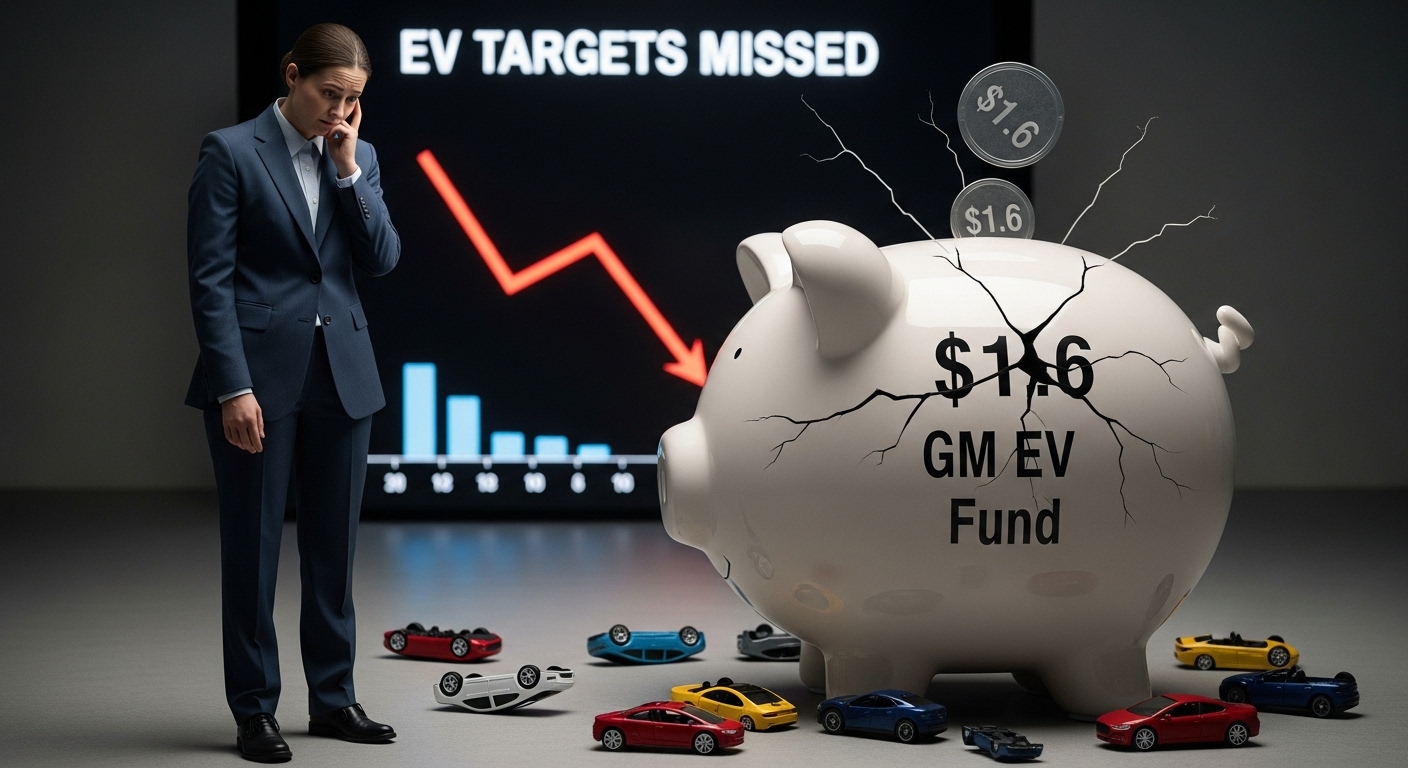
General Motors (GM), one of America’s most iconic automakers, has taken a sharp turn in its electric vehicle (EV) strategy. Once positioned as a leader in the race toward an all-electric future, GM has announced it will scale back parts of its EV program—resulting in a massive $1.6 billion financial hit.
The decision marks a major shift for a company that, just a few years ago, promised to phase out gasoline engines entirely by 2035. As market conditions, government incentives, and consumer demand change, GM’s latest move reflects the growing uncertainty surrounding the pace of the global EV transition.
The $1.6 Billion Blow: What Happened?
In its latest financial disclosure, GM confirmed that it will record a $1.6 billion charge as part of restructuring its EV business.
- Around $1.2 billion of the cost is tied to reductions in EV production capacity—essentially, the company is cutting back on planned EV manufacturing expansions and related infrastructure.
- Another $400 million accounts for contract cancellations, supplier settlements, and other exit costs linked to delayed or discontinued EV projects.
This move doesn’t mean GM is abandoning electric vehicles altogether—but it’s a strong signal that the company is slowing its pace to adjust to market realities.
From Ambitious Goals to Strategic Retreat
In 2021, GM’s CEO Mary Barra made global headlines by pledging that GM would become an all-electric automaker by 2035. The company invested billions in battery plants, EV assembly lines, and the Ultium platform, which was designed to power a new generation of electric cars and trucks.
However, just four years later, those ambitions are being recalibrated.
Several factors have pushed GM to revise its strategy:
- Weakening EV demand in the U.S., especially after the expiration of federal tax credits.
- High interest rates making EV financing less attractive for consumers.
- Rising production costs and supply-chain bottlenecks.
- Competition from more agile EV makers, particularly Tesla, BYD, and Korean brands like Hyundai and Kia.
According to analysts, GM’s retreat underscores a broader industry challenge—balancing long-term electrification goals with near-term profitability.
Read Also: Finances Are Getting Tighter’: U.S. Car Repossessions Surge as More Americans Default on Auto Loans
The Role of Expiring Federal Tax Credits
One of the biggest external blows to the EV industry came from the expiration of the federal $7,500 EV tax credit in September 2025.
This policy change removed a key incentive that had been driving EV adoption across the United States. Without the tax relief, the effective cost of owning an EV jumped significantly—particularly for middle-class buyers.
GM, which had planned aggressive EV rollouts under the assumption that such incentives would remain, suddenly faced lower demand projections. The company cited the policy change as a “material headwind” to its sales strategy.
Shifting Focus Back to Gasoline and Hybrid Vehicles
With EV demand cooling, GM is redirecting part of its focus toward gasoline and hybrid models, particularly in the profitable truck and SUV segments.
The company recently announced new investments totaling $4 billion in U.S. plants that will continue to produce internal-combustion vehicles. These include upgrades for popular models such as:
- Chevrolet Silverado
- GMC Sierra
- Cadillac Escalade
At the same time, GM plans to reintroduce hybrid technology—a category it largely ignored while chasing full electrification. The hybrid approach offers a middle ground for customers who want improved fuel efficiency but aren’t ready to rely solely on charging networks.
Market Reaction: Investor Caution
Investors reacted quickly to GM’s announcement. Shares of the company fell nearly 2% in pre-market trading, reflecting concerns about the cost of the restructuring and the slowdown in EV growth.
However, some analysts argued that GM’s move, while painful, could be financially prudent. By trimming unprofitable projects and refocusing on stronger market segments, GM may be able to protect short-term earnings while keeping its long-term EV ambitions alive.
A Reality Check for the EV Industry
GM’s $1.6 billion loss is more than a company-specific issue—it’s part of a broader reality check for the EV industry.
1. Demand Isn’t Keeping Up with Expectations
While EV sales have grown, they haven’t matched the explosive forecasts made during the pandemic years. Many consumers remain hesitant due to range anxiety, charging availability, and high upfront costs.
2. Incentive Fatigue
Governments worldwide are re-evaluating EV subsidies. As public funding tightens, automakers can no longer rely on taxpayer incentives to drive sales growth.
3. The Competitive Gap
Tesla’s cost efficiency and China’s low-cost EV exports are putting pressure on legacy automakers. Companies like GM and Ford face challenges scaling EVs profitably while maintaining traditional production lines.
GM’s Revised EV Roadmap
Despite the setback, GM isn’t walking away from electric mobility altogether. Instead, it’s adopting a more measured, market-driven approach.
Key Updates:
- Fewer EV launches: GM will prioritize profitable models, including the Cadillac Lyriq and Chevrolet Blazer EV.
- Flexible production lines: Factories will be configured to produce both EVs and gasoline vehicles, allowing quick adaptation to demand changes.
- Battery investments continue: GM’s Ultium battery joint ventures with LG Energy Solution will proceed but with revised output targets.
- Focus on hybrids: Expect a new lineup of plug-in hybrids by 2027 to bridge the transition.
This hybrid-first approach may mirror Toyota’s successful strategy of gradual electrification.
The Cost of Slowing Down
While the decision may reduce short-term risk, scaling back EV investments could have long-term implications for GM’s competitiveness.
- Reputation Risk – GM was once seen as a front-runner in EV innovation. Rolling back now may erode that image, especially as rivals push ahead.
- Regulatory Pressure – U.S. and European emission targets are tightening. GM may face higher compliance costs if its EV output slows.
- Technological Momentum – Developing batteries and software requires consistent R&D investment. Any slowdown risks falling behind on innovation.
A Balancing Act Between Profit and Progress
GM’s strategy reflects a larger balancing act faced by nearly every automaker today: how to remain profitable while navigating an inevitable—but unpredictable—EV transition.
- Ford recently delayed billions in EV investments amid similar challenges.
- Volkswagen cut EV production shifts in Europe due to slower demand.
- Tesla, though dominant, has also faced profit margin pressure as it cuts prices to maintain market share.
The pattern is clear: the global auto industry is entering a correction phase, where expectations are adjusting to economic and policy realities.
Lessons from GM’s EV Retrenchment
- Policy Stability Matters – Sudden changes to tax credits or regulations can disrupt massive corporate investments.
- Infrastructure is Key – Without adequate charging networks, mainstream consumers remain hesitant to switch.
- Affordability Still Rules – Until EVs can match gas cars in price, adoption will rely heavily on incentives.
- Hybrid Models Have a Future – A full shift to electric may take longer than predicted; hybrids offer a practical transition path.
The Road Ahead for GM
Moving forward, GM says it will focus on profitability and consumer flexibility. The company remains committed to electrification but at a pace that matches real-world demand.
Mary Barra reaffirmed that “EVs are the future,” but she also emphasized that GM will not “chase volume at the expense of financial discipline.” This pragmatic approach may help stabilize the company in the near term, even if it delays its original timeline.
Industry Outlook
Analysts expect GM’s EV slowdown to influence other automakers’ strategies. Some may also scale back expansion plans until clearer signs of profitability emerge.
Still, the long-term EV outlook remains positive. Battery costs are declining, charging infrastructure is expanding, and public sentiment continues to shift toward cleaner mobility. The journey may take longer than anticipated—but the direction remains the same.
Conclusion
General Motors’ $1.6 billion write-down is a stark reminder that the EV transition is not a straight path. Market volatility, policy uncertainty, and consumer hesitancy are reshaping how automakers plan their electric future.
By rolling back parts of its EV strategy, GM is prioritizing financial stability over rapid expansion—but this decision also underscores the growing pains of an industry in transformation.
For now, the message is clear: the electric dream is still alive, but automakers like GM must learn to navigate it with patience, pragmatism, and precision.
2 thoughts on “GM Takes $1.6 Billion Hit After Rolling Back Its EV Plans”