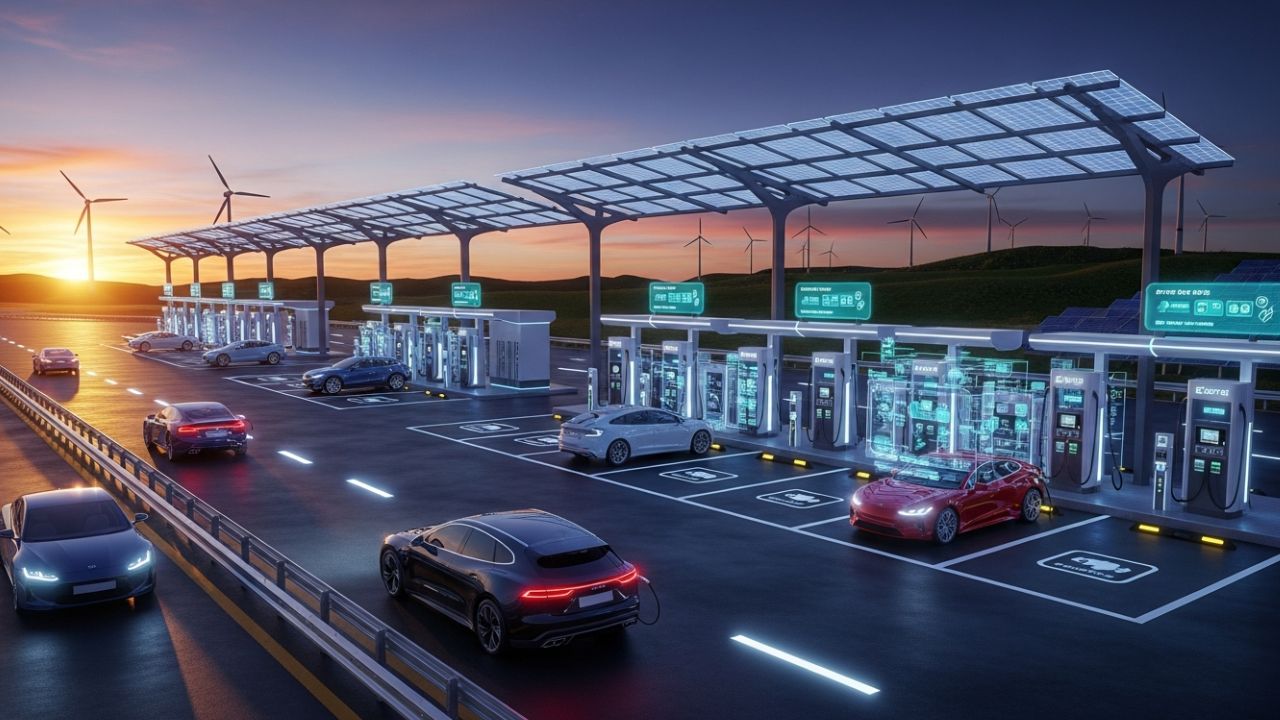
Fast-charging networks have transformed electric vehicle travel by 2025, enabling drivers to add hundreds of miles in under 30 minutes during road trips. Options like Tesla’s Supercharger and India’s Tata Power EZ Charge provide reliable stops, but differences in speed, cost, and availability can make or break a journey.
This comparison breaks down global and regional leaders, focusing on practical aspects for long-haul drivers. With EV adoption surging, understanding these networks ensures smoother, more affordable adventures across highways and beyond.
Basics of Fast-Charging Technology
Fast-charging delivers direct current (DC) to EV batteries at rates from 50 kW to 400 kW, far surpassing home Level 2 AC chargers at 7-22 kW. This technology skips the vehicle’s onboard converter, allowing rapid top-ups ideal for road trips where time is critical.

Standards vary: CCS Combo supports up to 350 kW and dominates in Europe, North America, and India, fitting vehicles like the Volkswagen ID.4 or Tata Nexon EV. CHAdeMO, common in Japan for Nissan models, caps at 150 kW but excels in bidirectional energy flow for grid support.
Tesla’s NACS connector, now adopted by Ford and GM, reaches 250 kW with seamless app integration. In China, GB/T standard powers 80% of the market at 250 kW. For international trips, adapters bridge gaps, but universal CCS pushes toward compatibility by 2026.
Battery preconditioning via apps optimizes sessions, reducing charge times by 20% on compatible networks. As EVs evolve, 800V architectures like those in the Porsche Taycan handle higher flows without overheating.
Read Also: Car Loan Refinancing Explained – How to Lower Your Monthly Payments
Leading Global Networks for Long-Distance Travel
Tesla’s Supercharger network stands out with over 50,000 stalls worldwide, clustered along major routes for minimal detours. V3 and V4 units deliver 250 kW, recharging a Model Y to 80% in 25 minutes while navigating via the car’s system.
Electrify America, backed by VW, features 4,800+ U.S. plugs at up to 350 kW, perfect for coast-to-coast drives. It expanded 30% in 2025, emphasizing renewable energy and multi-stall sites to handle peak traffic.
Europe’s IONITY, a BMW-Ford-Daimler venture, spans 1,000+ locations on autobahns with 350 kW CCS chargers, adding 200 km in 20 minutes. BP Pulse complements it with 70,000 points, blending fast DC and slower AC for versatile stops.
In Australia, Chargefox leads with 950 sites offering 350 kW, covering 90% of highways at renewable-backed stations. Evie Networks adds 325 rural-focused plugs, ensuring connectivity from Sydney to Perth.
These networks prioritize uptime and amenities, turning charges into quick breaks rather than hassles.
India’s Expanding Fast-Charging Ecosystem
India’s public charging infrastructure reached 29,000+ stations by late 2025, a 300% jump from 2023, driven by PM E-DRIVE initiatives. However, with 10 million EVs on roads, the ratio remains 1:235, highlighting urban-rural divides.
Tata Power EZ Charge operates 5,000+ points in 500 cities, with 150 kW DC fast chargers along NH-44 (Delhi-Chennai). It supports CCS and Bharat standards, charging a 60 kWh battery for ₹900 in 40 minutes.
ChargeZone’s 2,000+ stations focus on highways, delivering 100-120 kW at competitive rates, ideal for Mumbai-Goa runs. Statiq’s 3,500 plugs include solar-integrated units for two- and four-wheelers, expanding to tier-2 cities.
Jio-bp Pulse aims for 15,000 sites by 2027, offering 50-200 kW with UPI payments and battery swapping pilots. Government subsidies cover 40% of rural installs, boosting eastern corridors like Kolkata-Dhanbad.
Despite growth, monsoons and power outages challenge reliability, but 5G-enabled monitoring improves response times.
Coverage and Accessibility Evaluation
Effective coverage means stations every 50-150 km on key routes, preventing range anxiety. Tesla achieves near-100% U.S. interstate saturation with 10+ stalls per site, spacing 120 miles apart. Electrify America lags slightly at 80% coverage but densifies urban gateways.
IONITY’s European network follows motorways with 50 km intervals, 92% uptime ensuring predictable stops. In Australia, Chargefox’s 150 km rural gaps suit coastal drives, while Evie’s 325 sites fill inland voids.
India’s Tata EZ Charge spans 85% of golden quadrilaterals at 100 km spacing, but northeast routes stretch to 250 km. ChargeZone counters with 70% highway emphasis, adding 500 new plugs quarterly.
Global apps like Zap-Map or PlugShare map real-time availability, integrating traffic data for optimal routing. 2025 expansions target underserved areas, like India’s solar highways adding 1,000 km of embedded chargers.
Accessibility includes 24/7 access and disability-friendly designs—IONITY scores high with lit, secure bays. In India, urban stations often tie to malls for added convenience.
Speed Performance and Vehicle Compatibility
Charging speed hinges on kW output and vehicle limits—most EVs cap at 150-250 kW. Tesla’s 250 kW V3 adds 170 miles in 15 minutes for efficient models like the Model 3. Electrify America’s 350 kW peaks benefit 800V EVs, reaching 80% in 18 minutes for the Kia EV6.
IONITY matches 350 kW, ideal for long hauls, but CHAdeMO networks like Japan’s E-NEXCO top 100 kW, suiting shorter Japanese routes. Australia’s Chargefox offers 350 kW at 20% sites, averaging 200 kW for balanced performance.
In India, Tata’s 150 kW suffices for popular 40-60 kWh packs, adding 200 km/hour. ChargeZone’s 120 kW supports 95% local EVs via CCS/Bharat plugs. Compatibility issues arise with older CHAdeMO, but adapters cost $100-200.
Next-gen 400 kW chargers, piloted by BP, promise 10-minute sessions by 2027. Software updates enable dynamic power sharing at multi-stall sites, boosting efficiency 15%.
Pricing Structures and Cost Breakdown
Pricing mixes kWh rates, time-based fees, and subscriptions, varying by region and peak hours. Tesla averages $0.38/kWh in the U.S. ($19 for 50 kWh), dropping to $0.25 off-peak; annual pass saves 15%. Electrify America charges $0.43/kWh + $1/session ($22 total), with $4/minute tiers for slower speeds.
Europe’s IONITY bills €0.79/kWh ($0.85, €40 for 50 kWh), but memberships cut to €0.35 ($0.38). Australia’s Chargefox ranges free-$0.70/kWh ($0.47 avg, $24 for 50 kWh); Evie $0.58-0.75 with no session fees.
India shines affordably: Tata EZ Charge at ₹15/kWh ($0.18, ₹750 for 50 kWh), ChargeZone ₹12-18 ($0.14-0.22). GST adds 18%, but home solar offsets 50% of public needs. Road trip example: 1,000 km U.S. Tesla $40; India Tata ₹1,200 ($14).
Dynamic pricing responds to demand—peak surcharges hit 20%—but apps forecast costs. Renewables lower long-term rates, with IONITY 100% green.
Reliability Factors and Downtime Issues
Uptime averaged 93% globally in 2025, up 6% from 2024, per J.D. Power. Tesla leads at 95-98%, with remote diagnostics fixing 80% issues preemptively. Electrify America climbed to 90% after 2025 upgrades, reducing outages 25%.
IONITY’s 98% reliability stems from backup generators; Australia’s Chargefox hits 92%, Evie 87% in remote areas. Weather plays a role—U.S. blizzards cut 10%, India’s monsoons 15%.
In India, Tata EZ Charge reports 93% via AI monitoring, ChargeZone 89% with on-site teams. Power grid instability causes 20% rural failures, but microgrids mitigate. Apps alert users, rerouting to alternatives within 20 km.
Maintenance contracts ensure 99% peak uptime; Electrify’s partnerships with ABB boost hardware longevity. User reviews on Zap-Map flag persistent issues, improving networks iteratively.
Amenities, User Interface, and Convenience
Modern networks go beyond plugs, offering Wi-Fi, restrooms, and food to make waits enjoyable. Tesla sites often adjoin diners, with preconditioning via app for seamless starts. Electrify America partners with malls, providing shopping during 20-minute charges.
IONITY’s European hubs include lounges and EV washes; BP Pulse adds EV-specific parking. In Australia, Chargefox features picnic areas and playgrounds at family-friendly stops.
India’s Tata EZ Charge integrates with petrol pumps for hybrid refueling, apps supporting UPI and real-time slots. ChargeZone offers loyalty rewards, earning free kWh after 10 sessions. Interfaces vary—iOS/Android apps dominate, with RFID backups.
Satisfaction scores: Tesla 4.8/5, IONITY 4.6, Tata 4.3. Voice-guided navigation in EVs like Rivian enhances discovery. 2025 trends include AR previews of amenities.
Real-Life Road Trip Scenarios
A 2025 trans-U.S. drive from LA to NYC (2,800 miles) on Tesla took 4 days, 15 stops at $110, with zero queues thanks to navigation. Electrify America version added 3 hours from one outage but cost $130, suiting non-Tesla drivers.
Europe’s IONITY facilitated a Munich-Rome trip (1,000 km) in 2 days, 4 charges at €60, high speeds minimizing fatigue. Australia’s Chargefox enabled Sydney-Brisbane (900 km) with 5 stops at $45 AUD, amenities praised for family travel.
In India, Delhi-Bengaluru (2,200 km) via Tata EZ Charge: 10 hours driving, 7 charges at ₹2,500 ($30), one delay in Rajasthan. ChargeZone alternative saved ₹800 but faced urban congestion. These trips underscore planning—dense networks cut 20% time.
Read Also: Top Car Loan Providers 2025 – Global Comparison (USA, UK, UAE, Australia, Canada)
Emerging Innovations and Future Directions
Ultra-fast 400-500 kW chargers, like bp’s Gigahubs, will halve times by 2028, supporting 1,000V systems. Wireless charging pilots on highways add miles dynamically.
India targets 100,000 stations by 2030, with 50% solar-powered for green credentials. Global convergence on NACS/CCS reduces adapters; AI routes avoid crowds, saving 15% time.
Costs could fall 25% via economies of scale, subscriptions standard at $10/month. Bidirectional charging lets EVs power homes during outages. Sustainability mandates 100% renewables by 2030.
Equity initiatives expand rural access, narrowing urban-rural gaps. By 2035, networks will enable seamless global EV travel.
Conclusion
Fast-charging networks in 2025, from Tesla’s reliability to Tata’s affordability, make EV road trips practical and enjoyable. Select based on your route—dense CCS options for efficiency—and use apps for optimization. As innovations accelerate, these systems promise even greater freedom for electric explorers.
1 thought on “Comparison of Fast-Charging Networks for EV Road Trips”