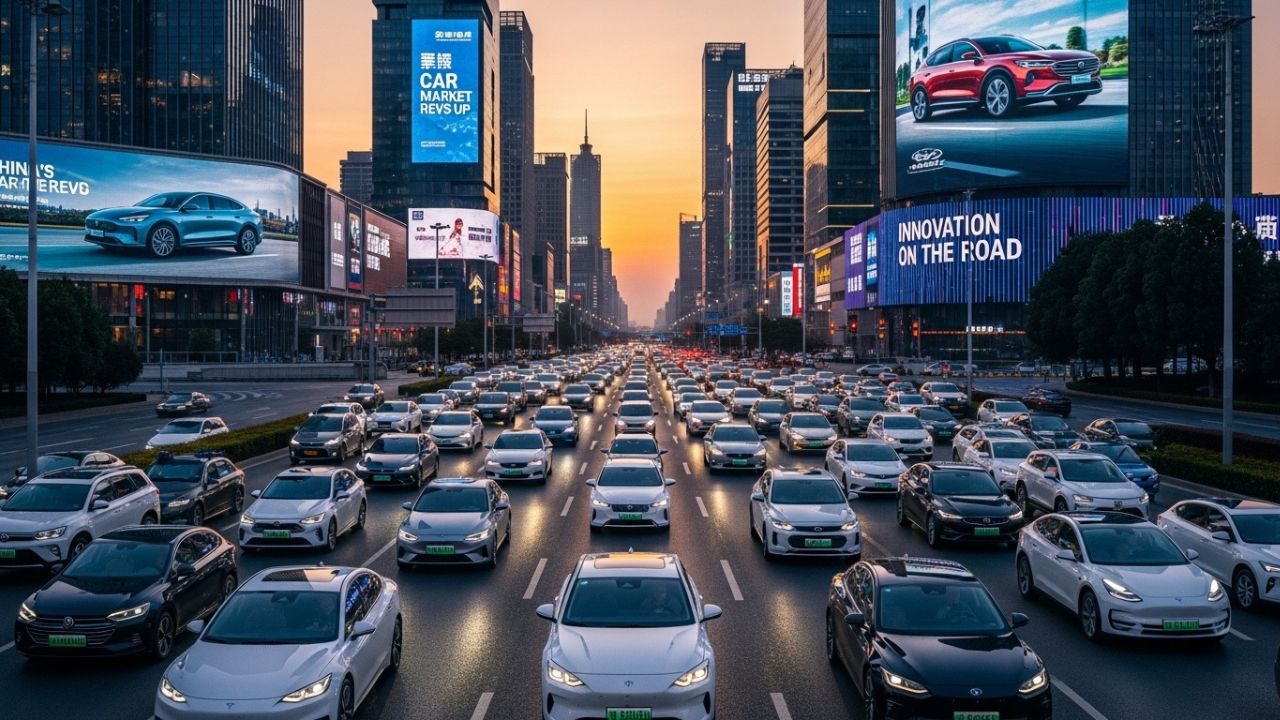
China’s automotive landscape is undergoing a dramatic transformation. Once known for its mass production of gasoline vehicles, the world’s largest car market is now rewriting history — and leading the global shift toward new-energy vehicles (NEVs).
In September 2025, China achieved a major milestone: electric and hybrid vehicles accounted for more than half of all new car sales. This landmark moment signals not just a change in consumer preference, but also a massive pivot in national energy strategy, industrial policy, and technological innovation.
With over 2.3 million passenger vehicles sold in a single month, and NEVs making up 57% of those sales, China has once again proven itself as the epicentre of the electric vehicle (EV) revolution.
This surge has implications that extend far beyond China’s borders — reshaping global supply chains, redefining competition for automakers worldwide, and accelerating the planet’s transition toward sustainable mobility.
A Historic September: Breaking Records in China’s Auto Market
September has long been considered China’s “Golden Month” for car sales, as festive discounts and consumer incentives drive buying sprees. But this year was different.
According to data from the China Passenger Car Association (CPCA), passenger vehicle sales rose 6.6% year-on-year, reaching 2.3 million units in September 2025. While this growth is impressive in itself, the real highlight lies in what consumers chose to buy — new-energy vehicles.
Electric and hybrid models surged 16% compared to last year, capturing a record 57% market share.
This means one out of every two cars sold in China is now powered by electricity or a hybrid system — a stunning turnaround from just five years ago when such cars were considered niche products.
Read Also: First Look: The BYD Atto 1 – A Peek at a Budget-Friendly Electric SUV
The Driving Forces Behind the Surge
- Government Policies and Incentives:
China’s government has aggressively promoted NEVs through subsidies, tax breaks, and stringent emission regulations. Local governments also offer perks like free registration plates, reduced tolls, and charging infrastructure expansion. - Technological Advancements:
Breakthroughs in battery efficiency, charging speed, and vehicle range have made modern EVs more practical for everyday users. - Consumer Awareness:
Rising fuel prices and growing environmental consciousness among young buyers have shifted the perception of electric vehicles from luxury to necessity. - Brand Confidence:
Chinese automakers like BYD, Li Auto, XPeng, and NIO have gained consumer trust with high-quality, tech-rich, and competitively priced models.
The Dominance of Domestic Brands: A New Era of Competition
One of the most remarkable aspects of China’s current auto boom is the dominance of homegrown automakers.
In the early 2000s, foreign carmakers such as Volkswagen, Toyota, Honda, and General Motors ruled the market. Today, however, the tables have turned.
Brands like BYD (Build Your Dreams), Li Auto, XPeng, and NIO are now household names, competing head-to-head — and often outperforming — global giants.
BYD: The Unstoppable Force
BYD continues to be the undisputed leader in China’s EV market. Its diverse lineup — including popular models like the Seal, Dolphin, Atto 3, and Song Plus — caters to every segment from compact cars to luxury sedans and SUVs.
BYD’s strategy of manufacturing both battery cells and vehicles gives it unmatched cost control and technological integration. In fact, the company’s Blade Battery technology, known for its safety and durability, has set new industry standards.
Li Auto and XPeng: Innovators in Hybrid and Smart Tech
Li Auto has carved a unique niche with its range-extended EVs (REEVs) — vehicles that use small petrol generators to recharge the electric battery. This approach appeals to consumers anxious about range limitations while maintaining eco-friendly credentials.
XPeng, meanwhile, is pushing the boundaries of autonomous driving and smart connectivity, aiming to become the “Tesla of China” through advanced AI-driven features.
NIO: The Luxury Challenger
NIO continues to focus on the premium EV market, rivaling European luxury automakers. Its battery-swapping technology — allowing users to replace batteries in minutes — is a game-changer, reducing charging downtime significantly.
Foreign Carmakers Feel the Heat
The rise of domestic EV champions has intensified competition for foreign brands operating in China. Companies like Tesla, Volkswagen, and Toyota face increasing pressure to adapt quickly or risk losing market share.
Tesla remains a major player, with its Shanghai Gigafactory producing hundreds of thousands of vehicles annually. However, the price war initiated by Tesla earlier this year forced many local and foreign automakers to cut prices to stay competitive.
Volkswagen and Toyota have also accelerated their electric transformation, unveiling new EV platforms and partnerships with Chinese tech companies to stay relevant in this fast-changing environment.
How Government Policy Fuels the EV Revolution
China’s commitment to carbon neutrality by 2060 lies at the heart of this transformation. The government’s “dual-carbon” strategy — aiming to peak carbon emissions before 2030 and achieve neutrality by 2060 — heavily promotes NEV adoption.
Key Policy Drivers
- Subsidies and Tax Incentives: Buyers receive tax exemptions or discounts for purchasing electric or hybrid vehicles.
- License Plate Privileges: In many major cities, EV owners skip long lottery waits for registration plates, which can take years for petrol cars.
- Infrastructure Expansion: China now has over 8 million public charging points, making it the largest EV charging network in the world.
- Local Manufacturing Support: Regional governments offer incentives for domestic production and innovation, particularly in battery and semiconductor technology.
These policies have created a perfect ecosystem for NEVs to thrive, combining public enthusiasm, corporate investment, and government backing into a unified momentum.
Consumer Trends: What Chinese Buyers Want
Chinese consumers are among the most digitally connected and tech-savvy in the world. Their purchasing habits reflect an appetite for innovation, efficiency, and environmental responsibility.
Top Factors Driving NEV Adoption
- Smart Features: Buyers now expect AI assistants, voice controls, and autonomous driving functions as standard in premium EVs.
- Affordability: The cost gap between EVs and traditional cars has narrowed, with models like the BYD Dolphin and Wuling Bingo offering high-tech features at affordable prices.
- Design and Aesthetics: Modern Chinese EVs blend sleek design with futuristic interiors, appealing to younger demographics.
- Charging Convenience: The rapid expansion of fast-charging networks makes long-distance EV travel increasingly feasible.
Demographic Insights
- Millennial and Gen Z buyers dominate the NEV market, viewing electric mobility as a lifestyle statement.
- Urban professionals prefer compact EVs for daily commuting.
- Families gravitate toward hybrid SUVs that balance performance with practicality.
The Economic Impact: Beyond the Roads
The EV boom isn’t just transforming car showrooms — it’s reshaping China’s economy.
1. Boost to Manufacturing and Exports
China is now the largest exporter of electric vehicles, shipping cars to Europe, Southeast Asia, and Latin America. Brands like BYD and SAIC Motor have expanded rapidly into global markets, exporting not just vehicles but also batteries and EV components.
2. Job Creation and Technological Innovation
The rapid growth of the NEV sector has created millions of new jobs in manufacturing, battery production, and software development. It has also fostered technological breakthroughs in energy storage, smart mobility, and renewable integration.
3. Reduced Oil Dependence
With more than half of all new cars being electric or hybrid, China is gradually reducing its dependence on oil imports, strengthening its energy security and environmental resilience.
Challenges Ahead: Not All Smooth Roads
Despite the remarkable success, China’s NEV sector faces challenges that could test its resilience in the coming years.
1. Market Saturation and Price Wars
As more brands flood the market, intense price competition could squeeze profit margins, forcing consolidation among smaller players.
2. Charging Infrastructure Gaps
While major cities boast dense charging networks, rural and remote regions still face limited infrastructure, which could hinder nationwide adoption.
3. Environmental Costs of Battery Production
The demand for lithium, cobalt, and nickel — essential for EV batteries — has raised concerns about mining practices and environmental impact. Sustainable sourcing and recycling will be key priorities moving forward.
4. Global Trade Tensions
As Chinese automakers expand abroad, trade disputes and tariffs could create friction with Western markets wary of China’s growing influence in the EV sector.
Global Implications: China Sets the Pace for Electrification
China’s rapid embrace of new-energy vehicles is reshaping the global automotive industry. What happens in China no longer stays in China — it dictates trends worldwide.
1. Supply Chain Realignment
Global carmakers are increasingly dependent on Chinese suppliers for lithium batteries, rare earth materials, and semiconductors. China’s dominance in these sectors gives it strategic leverage in the global clean energy race.
2. Technology Transfer
China’s advancements in battery swapping, solid-state batteries, and AI-driven driving systems are now influencing automakers in Europe, Japan, and the U.S.
3. Environmental Progress
The rapid shift toward NEVs has significantly contributed to reducing carbon emissions, helping global efforts to combat climate change.
What This Means for Investors and Automakers
For investors, China’s booming EV sector presents tremendous long-term growth opportunities. With the NEV market projected to expand by over 25% annually, both domestic and foreign stakeholders are pouring billions into R&D, production facilities, and EV infrastructure.
Automakers that can adapt quickly — through partnerships, innovation, and market localization — stand to gain the most. Companies slow to embrace electrification risk becoming obsolete in the next decade.
The Road Ahead: The Future of China’s Auto Industry
The shift toward NEVs marks not just a trend, but a permanent evolution in China’s mobility landscape. Analysts predict that by 2030, electric and hybrid vehicles could account for up to 80% of new car sales in the country.
With continued government backing, advancing battery technology, and growing consumer confidence, China is well-positioned to become the first major economy to achieve full-scale electrification in personal transport.
Read Also: Diwali 2025 Car Launches in India: Five Game-Changing Vehicles to Watch
FAQs: China’s New-Energy Vehicle Boom
1. What are new-energy vehicles (NEVs)?
NEVs include battery electric vehicles (BEVs), plug-in hybrid vehicles (PHEVs), and fuel-cell vehicles (FCEVs) — all powered by alternative energy sources rather than traditional fossil fuels.
2. How many electric vehicles are sold in China annually?
As of 2025, China sells over 2 million NEVs per month, meaning annual sales could exceed 20 million units if the trend continues.
3. Which brands dominate the Chinese EV market?
Domestic giants such as BYD, Li Auto, XPeng, and NIO lead the market, with Tesla maintaining a strong presence as a foreign competitor.
4. Is China exporting electric vehicles globally?
Yes. China has become the largest EV exporter, with BYD, SAIC, and Geely exporting to Europe, Latin America, and Southeast Asia.
5. What challenges does China face in its EV transition?
Key challenges include battery recycling, price wars, infrastructure development, and raw material sustainability.
Conclusion: China Drives the Global EV Revolution
China’s car market has officially entered a new era — one dominated by clean energy, smart technology, and national innovation. The rise of new-energy vehicles reflects not just economic growth but a cultural transformation toward sustainability.
By surpassing the 50% mark in NEV sales, China has shown the world what’s possible when policy, technology, and consumer demand align for a common goal.
The road ahead may have challenges, but one thing is certain — the future of mobility is electric, and China is driving it forward at full throttle.
1 thought on “China’s Car Market Revs Up: New-Energy Vehicles Take the Lead in a Historic Shift”