
Buying a new car in 2025 is more complicated than ever. With rising vehicle prices, fluctuating interest rates, new tax policy changes, and the rapid shift toward electric vehicles, deciding whether to lease or buy has become a major financial decision. The classic comparison—“lease for lower payments, buy for long-term value”—still applies, but the details in 2025 look very different from just a few years ago.
Government EV incentives have shifted. Residual values for some car models are unpredictable. Loan APRs have changed. These factors have made the lease vs loan question more nuanced, especially for tech-heavy models like EVs.
This comprehensive guide breaks down everything you need to know: monthly costs, equity, incentives, EV factors, mileage needs, long-term ownership value, and real-world examples. By the end, you’ll be able to confidently decide whether leasing or buying makes the smartest financial sense in 2025.
Car Lease vs. Loan: The Core Difference
Before diving deeper, here’s a simple explanation:
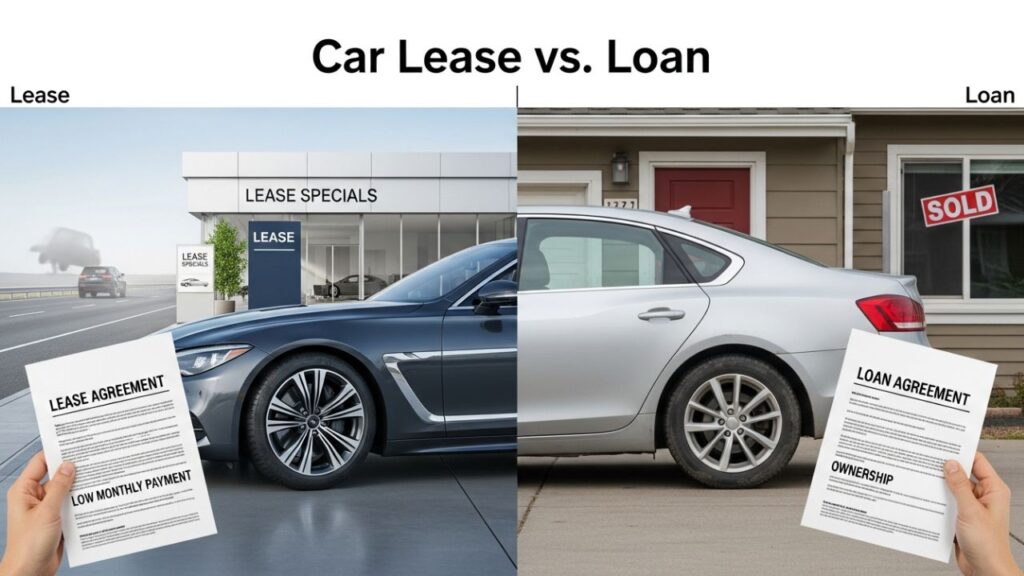
Buying (Car Loan):
- You finance the full price of the car.
- Payments go toward principal + interest.
- After the loan ends, the car is completely yours.
- You can drive unlimited miles and modify the vehicle.
- Long-term ownership usually saves money.
Leasing a Car:
- You pay for the usage (depreciation) of the car over a fixed period.
- Payments are usually lower than loan payments.
- You must follow mileage and wear restrictions.
- You don’t own the car unless you buy it at lease-end.
- You get newer cars more frequently.
Both have advantages, but the smartest option depends on your lifestyle, budget, and long-term plans.
Why This Decision Is More Important in 2025
Compared to 2020 or 2023, the auto market in 2025 has undergone major shifts:
1. Higher Car Prices
Across many markets, average vehicle prices—both electric and gasoline—have increased. This affects affordability and pushes more people toward leasing.
2. Rising Loan APRs
Auto loan interest rates have climbed over the last few years, making car loans more expensive and monthly payments higher.
3. Changing EV Incentives
Certain tax credits and leasing incentives have changed or expired. This impacts the attractiveness of EV leasing.
4. Residual Value Uncertainty
Modern EVs and fast-updating models (especially with new battery technology) have unpredictable resale values.
5. Subscription and flexible ownership models
More buyers want flexibility, making leasing appealing for tech-first consumers.
Because of these factors, the classic “lease for short-term, buy for long-term” rule still applies—but the financial difference can be larger or smaller depending on your car and usage.
Read Also: Nio Exports 431 Cars in October 2025 — Firefly Expands to Europe & North America
Detailed Breakdown: Lease vs. Loan in 2025
Below is a deep comparison across every major factor: payments, flexibility, costs, EV considerations, and resale value.
1. Monthly Cost Comparison
Leasing
- Monthly payments are typically 20–40% lower than loan payments.
- You’re only paying the expected depreciation, not the full value.
- Lower payments free up cash for savings, investments, or emergencies.
Best for: budget-conscious buyers, new drivers, business owners.
Loan (Buying)
- Monthly payments are higher because you’re financing the entire car.
- Loan APRs significantly influence cost.
- After the loan ends, monthly payments drop to zero.
Best for: long-term planners, high-mileage drivers, families.
2. Equity: What Do You Own?
Leasing
- You build zero equity.
- At the end of the term, you return the car or choose to buy it.
Buying
- Every EMI increases your ownership stake.
- After the loan ends, the car becomes an asset.
WINNER: Buying, if long-term ownership matters.
3. Flexibility & Control
Leasing
- You cannot modify the car.
- Must follow mileage limits (10k–15k miles per year typical).
- Excess wear costs can apply.
- Early termination fees are high.
Buying
- Total freedom to modify, repaint, tune, or customize.
- Drive unlimited miles with no penalties.
- Sell anytime you wish.
WINNER: Buying—for full freedom.
BUT: Leasing is excellent for drivers who want a different car every 2–4 years.
4. Vehicle Technology and EV Trends
This factor didn’t matter much in 2010—but today it’s HUGE.
Why Leasing is Popular for EVs in 2025
- Battery tech is improving fast, making older EVs depreciate quickly.
- Leasing protects you from owning a low-resale-value EV.
- New safety and autonomous driving features get updated every 1–2 years.
- Some EV tax incentives apply only to leases.
Why Buying Still Makes Sense
- If EV tech stabilizes, owning remains better financially.
- Long-term EV maintenance is cheaper (especially for trusted brands).
- Buying helps avoid potential increases in lease-end buyout prices.
BOTTOM LINE:
Leasing an EV is generally smarter in 2025 if incentives reduce the cost.
Buying is smarter for hybrid or traditional vehicles you plan to keep long-term.
5. Depreciation & Resale Value
Leasing
- Depreciation risk is the leasing company’s problem.
- You don’t worry about resale.
Buying
- You carry all the depreciation risk.
- Depreciation varies:
- Luxury cars depreciate fastest
- Hybrids and fuel-efficient models depreciate slower
- EV depreciation is unpredictable
- Luxury cars depreciate fastest
If you worry about future resale → leasing is safer.
6. Mileage Considerations
Leasing
- Standard leases allow 10k–15k miles per year.
- Extra miles cost money (e.g., $0.20–$0.35 per mile).
- Road-trippers or rural drivers may get expensive penalties.
Buying
- Unlimited miles.
WINNER: Buying — no restrictions.
7. Repair & Maintenance
Leasing
- Lease term usually matches the manufacturer warranty (3–4 years).
- Maintenance costs are minimal.
- Less stress about major repairs.
Buying
- Repairs after warranty can be costly.
- But long-term owners often save money once the car is paid off.
WINNER: Leasing — predictable maintenance.
Buying wins long-term once past the loan period.
8. Total Long-Term Cost (5–10 Years)
If you evaluate 5–10 years:
Leasing repeatedly
- You always have a payment.
- You never own the car.
- Highest total lifetime cost.
Buying and keeping the car
- Higher cost in first 3–5 years.
- Lowest cost in the long run.
- No payments for many years after the loan.
WINNER: Buying — best for long-term financial health.
Practical 2025 Example: Lease vs. Loan
Let’s compare two real-world scenarios.
Scenario: A $35,000 SUV
Lease (36 months)
- Monthly payment: ~$520
- Upfront cost: $2,500
- Total 3-year cost: ~$21,700
- No ownership
Buy (Loan: 60 months, 6.5% APR)
- Monthly payment: ~$680
- Total paid after 3 years: ~$24,480
- Car resale value after 3 years: ~$18,000
- Net cost: ~$6,480
Interpretation
- Leasing is cheaper monthly.
- Buying costs more monthly, but long-term cost is far lower.
Who Should Lease in 2025?
Choose leasing if you:
- Want lower monthly payments
- Drive fewer than 12,000 miles per year
- Prefer changing cars every 2–4 years
- Want to avoid depreciation risk
- Want access to new EV tech & incentives
- Like predictable maintenance costs
- Need a car for business (tax benefits may apply)
Ideal for: urban drivers, EV early adopters, tech lovers, business users.
Who Should Buy (Loan) in 2025?
Choose buying if you:
- Plan to keep the car for 5–10+ years
- Want unlimited miles
- Drive long distances
- Value freedom to modify or customize
- Want to build equity in the vehicle
- Want the lowest long-term ownership cost
- Want predictable ownership without lease rules
Ideal for: families, high-mileage drivers, rural drivers, long-term planners.
Cost of Leasing vs Buying in 2025: Detailed Breakdown
Below is a side-by-side comparison:
| Feature | Lease | Loan (Buy) |
| Monthly payment | Lower | Higher |
| Down payment | Low to medium | Medium to high |
| Ownership | No | Yes |
| Resale value | Not your concern | Your responsibility |
| Mileage limits | Yes | No |
| Customization | No | Yes |
| Long-term cost (10 years) | High | Low |
| Best for | Short-term users | Long-term owners |
Hidden Costs Many People Forget
Leasing Hidden Costs
- Excess mileage fees
- Wear-and-tear penalties
- Lease acquisition fee
- Lease disposition fee
- High early termination fee
- Higher insurance requirements
Buying Hidden Costs
- Higher down payment
- Higher monthly EMIs
- Long-term maintenance
- Depreciation is your risk
Make sure to check every fee before deciding.
Read Also: China Expected to Fully Approve Tesla FSD by Early 2026, Says Elon Musk
Lease-End Options in 2025
When your lease ends, you typically have 3 choices:
1. Return the car
No further payment unless damaged or exceeded mileage.
2. Buy the car (Lease Buyout)
Great if:
- Residual value is lower than market value
- You love the car
- Used car prices are unusually high
3. Trade it for another lease
Best for drivers who want constant upgrades.
Smart Tips for Choosing Between Lease and Loan
1. Estimate Your Mileage Honestly
If you frequently exceed 15,000 miles/year → buying is safer.
2. Compare Total Cost, Not Just Monthly Payment
Monthly payments alone are misleading.
3. Consider EV vs Gas
- EVs → better to lease if you worry about battery tech updates.
- Hybrids/gas models → often better to buy.
4. Refinance Loans if APR Drops
Lower interest rates = lower EMI = smarter ownership.
5. Choose a Lease Only If You Clearly Understand the Contract
Read every clause, especially:
- Mileage limits
- Wear rules
- Buyout price
- Excess usage fees
Conclusion: Lease or Buy — Which Is Smarter in 2025?
Lease is smarter if:
- You want a lower monthly cost
- You plan to upgrade early
- You drive limited miles
- You want newer tech (especially EVs)
- You prefer predictable costs
Buy is smarter if:
- You want long-term value
- You want to keep your car 5–10+ years
- You’re a high-mileage driver
- You want flexibility and full control
- You want the lowest lifetime cost
In 2025, the smarter choice ultimately depends on your lifestyle, not just money. Leasing delivers convenience and lower payments; buying delivers freedom and long-term savings.