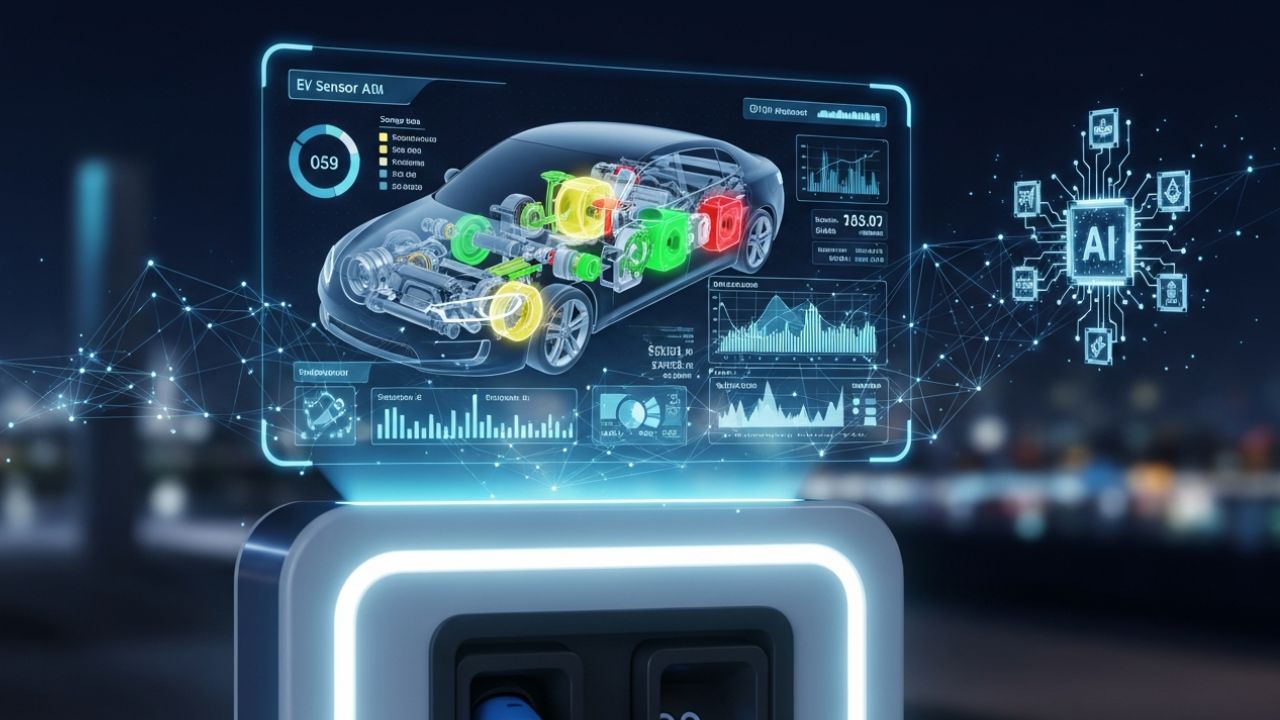
Electric vehicles (EVs) in 2025 rely on AI-driven predictive maintenance to anticipate failures in batteries, motors, and chargers, potentially cutting repair bills by 25-40% through timely alerts and proactive fixes. As global EV fleets expand to over 50 million units, this technology analyzes real-time data from thousands of sensors to prevent costly breakdowns, enhancing reliability and owner confidence.
Shifting from traditional reactive repairs, AI enables just-in-time servicing, minimizing downtime that can cost fleets $500 per hour. In emerging markets like India, where EV infrastructure is scaling rapidly, these systems optimize operations amid challenging conditions like extreme heat. This article delves into how AI transforms EV upkeep, backed by real-world examples and future insights.
Understanding Predictive Maintenance for EVs
Predictive maintenance uses data analytics and machine learning to forecast equipment failures, drawing from IoT sensors embedded in EV components. It moves beyond fixed schedules, instead processing live inputs like temperature and vibration to estimate remaining useful life (RUL) with up to 95% precision.
For EVs, this means monitoring complex systems where failures can cascade—such as a battery anomaly leading to motor strain. AI models, trained on historical datasets, detect patterns invisible to human eyes, like a 2% efficiency drop signaling inverter issues.
Implementation starts with sensor networks collecting 1-10 GB daily per vehicle, fed into cloud or edge platforms for analysis. This approach boosts overall equipment effectiveness (OEE) by 20%, crucial as EVs integrate more software-defined features.
In India, with EVs projected to hit 10 million by 2030, predictive tools align with FAME schemes, reducing warranty claims and supporting sustainable growth. Early adopters report 30% fewer service visits, proving its edge over preventive methods.
Read Also: Tech Innovations in Car Safety: New Sensors, AI, and Crash-Avoidance Systems
AI Technologies Powering EV Predictions
Machine learning forms the backbone, with algorithms like random forests and support vector machines classifying faults from sensor streams. Deep learning variants, such as convolutional neural networks (CNNs), process imaging data from cameras to spot external wear on cables or underbodies.
Recurrent neural networks (RNNs) excel at time-series analysis, tracking trends in charge cycles to predict battery degradation months ahead. Hybrid models combining long short-term memory (LSTM) with feedforward networks achieve 91% accuracy in RUL estimates for lithium-ion packs.
Edge computing processes data onboard, cutting response times to milliseconds and easing bandwidth burdens—vital for remote Indian highways. Natural language processing (NLP) even interprets diagnostic logs, automating report generation for technicians.
Federated learning allows models to improve across fleets without sharing raw data, addressing privacy under regulations like India’s DPDP Act. These tech stacks evolve rapidly, with 2025 updates incorporating generative AI for scenario simulations.
Battery Health: AI’s Primary Focus
EV batteries, accounting for 30-50% of vehicle costs, degrade via factors like thermal cycling and deep discharges—AI tracks these via battery management systems (BMS) to forecast state-of-health (SoH). Models analyze voltage curves and impedance, predicting capacity loss with a mean absolute error (MAE) below 3%.
By flagging imbalances early, AI prevents thermal runaway, a risk in 5% of incidents, through dynamic cooling adjustments that extend life by 20-30%. In hot climates like India’s Rajasthan, where heat accelerates wear, predictions adjust charging limits to maintain 85% capacity after 100,000 km.
Real-time range forecasting integrates weather and terrain data, reducing “surprise” shortfalls by 35%. For fleets, AI optimizes pack balancing, cutting replacement needs 25%—a $10,000 saving per unit.
Over-the-air (OTA) updates refine algorithms, as seen in pilots where SoH accuracy rose 15% post-deployment. This proactive stance transforms batteries from cost centers to durable assets.
Monitoring Motors, Inverters, and Drivetrains
Electric motors endure high torque but suffer from bearing fatigue and winding insulation breakdown—AI uses accelerometers to detect vibrations exceeding 0.5g, forecasting failures 4-6 weeks in advance.
Inverters, converting DC to AC, face harmonic distortions; predictive models spot these via current waveform analysis, preventing efficiency drops that hike energy use 10%. Drivetrain gears benefit from torque sensor data, with AI alerting on misalignment to avert chain reactions.
Tesla’s neural nets process 5TB daily across its fleet, preempting motor swaps and saving 28% on repairs. In Indian logistics, where dusty roads accelerate wear, these systems schedule cleanings, extending component life 18 months.
Integration with vehicle-to-everything (V2X) communication shares anomaly data fleet-wide, boosting collective accuracy to 94%. Challenges like sensor drift are mitigated by self-calibrating AI, ensuring robust predictions.
Enhancing Charging Infrastructure Reliability
EV chargers, from home units to public hubs, see AI predict overloads and connector faults by monitoring power draw and thermal profiles. Machine learning detects anomalies like a 5% voltage sag, scheduling fixes before queues form.
For onboard chargers, AI analyzes session data to prevent overvoltage, which causes 15% of failures. Bidirectional systems gain from predictions ensuring safe grid returns, vital for V2G pilots in Europe and India.
In India’s 35,000+ stations by late 2025, AI reduces monsoon-induced outages 22% via weather-integrated models. Operators like Tata Power use it for just-in-time part stocking, slashing downtime costs $300 per hour.
Cloud platforms aggregate network data, enabling predictive scaling—e.g., boosting capacity pre-peak hours. This not only cuts repairs but optimizes energy use, aligning with renewable integrations.
Tesla’s Approach: Fleet-Scale AI Innovation
Tesla’s ecosystem exemplifies AI maintenance, with its Dojo supercomputer training on 1.5 billion miles of data for 98% fault prediction. The BMS flags cell-level issues, triggering OTA software tweaks to balance loads and avert degradation.
In production, AI monitors assembly robots, predicting jams 48 hours ahead and reducing line stops 35%. For consumers, the app sends alerts like “brake pad replacement in 500 km,” based on regenerative braking patterns.
A 2025 U.S. study showed Tesla owners saved $1,500 yearly via preempted visits, while Indian ride-hailing fleets cut motor claims 32%. Privacy is handled via edge processing, complying with global standards.
Limitations include dependency on connectivity, but satellite backups like Starlink address this. Tesla’s open-sourcing of some models inspires competitors, accelerating industry-wide adoption.
BMW’s Integrated Predictive Framework
BMW’s ConnectedDrive platform employs AI to analyze 200+ sensors, predicting suspension wear from road data and alerting via My BMW app. For EVs like the iX, it focuses on thermal management, forecasting coolant needs with 87% accuracy.
Proactive Care resolves 65% of issues remotely, from software glitches to tire pressure anomalies, minimizing shop time. In fleet ops, it integrates with logistics software for grouped servicing, saving 22% on labor.
European trials reported 27% repair reductions, while India’s BMW i-series pilots in Mumbai achieved 19% lower costs amid humid conditions. The system uses explainable AI, showing users prediction rationales to build trust.
Challenges: High data volumes strain older models, but 2025 updates add compression tech. BMW’s partnerships with NVIDIA enhance edge AI, paving for AR-assisted repairs.
Advantages for Commercial EV Fleets
Fleets, comprising 40% of 2025 EV sales, leverage AI for dynamic routing that factors maintenance windows, avoiding peak-hour breakdowns and saving 18% on fuel equivalents.
Predictive downtime modeling schedules services during off-hours, boosting utilization to 95%. In India, companies like BluSmart use it to monitor 5,000+ vehicles, cutting battery swaps 28% and operational costs $0.05/km.
Safety improves as AI detects driver fatigue correlations with component stress, reducing accidents 15%. ROI hits 3:1 within 18 months, with scalable cloud solutions fitting small to large operators.
Sustainability perks include optimized energy, lowering emissions 12% via efficient runs. As 5G rolls out in India, real-time fleet syncing will further amplify gains.
Overcoming Implementation Barriers
Data quality issues, like noisy sensors in dusty environments, can skew predictions 8-12%—AI filters and calibration routines counter this. Initial investments of $3,000-8,000 per vehicle yield payback in 12-24 months via savings.
Privacy risks from location tracking demand anonymization and consent frameworks, as per EU GDPR and Indian laws. Skill gaps require training, with 70% of technicians needing upskilling by 2027.
False alarms, at 4-7%, frustrate users; advanced validation layers reduce them to 2%. In variable Indian terrains, hybrid models blending local data improve resilience.
Vendor lock-in from proprietary systems is easing via open standards, fostering interoperability. Regulatory support, like IRDAI guidelines, accelerates adoption.
Read Also: AI in Car Loan Approval – How Fintech Is Changing Auto Financing
Emerging Innovations and Long-Term Vision
Digital twins—virtual EV replicas—simulate stresses in 2025 pilots, predicting failures with 99% fidelity and enabling virtual testing. Quantum-enhanced AI could handle exabyte-scale data for nano-precise forecasts by 2030.
Blockchain secures shared diagnostics across OEMs, cutting fraud 40%. In India, AI-V2G hybrids will let vehicles self-regulate based on grid predictions, extending hardware life 25%.
Edge-5G fusions enable autonomous repairs, like drone-delivered parts. Sustainability integrates AI with recycling analytics, minimizing e-waste 45%. The market, valued at $15B now, eyes $100B by 2035.
Ethical AI ensures equitable access, with subsidies for small Indian fleets. These trends promise near-zero unplanned downtime, redefining EV ownership.
Conclusion
AI predictive maintenance is reshaping EV reliability, driving down repair costs 30%+ by foreseeing issues in batteries, motors, and beyond. From Tesla’s data empires to BMW’s user-centric alerts, it delivers tangible savings and safety for individuals and fleets alike. As barriers fade and innovations surge—especially in growth hubs like India—the electric future looks more dependable and affordable than ever.